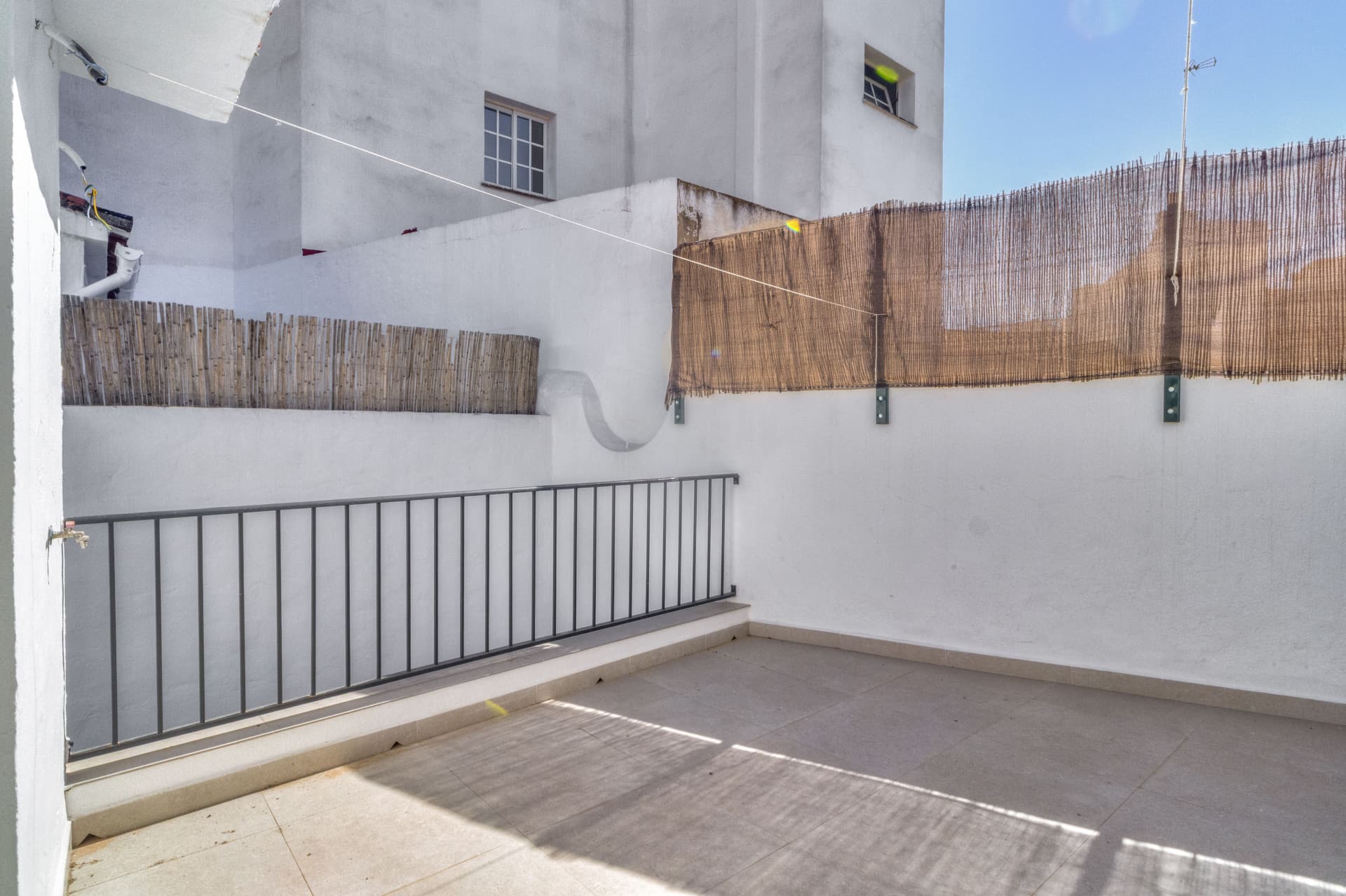
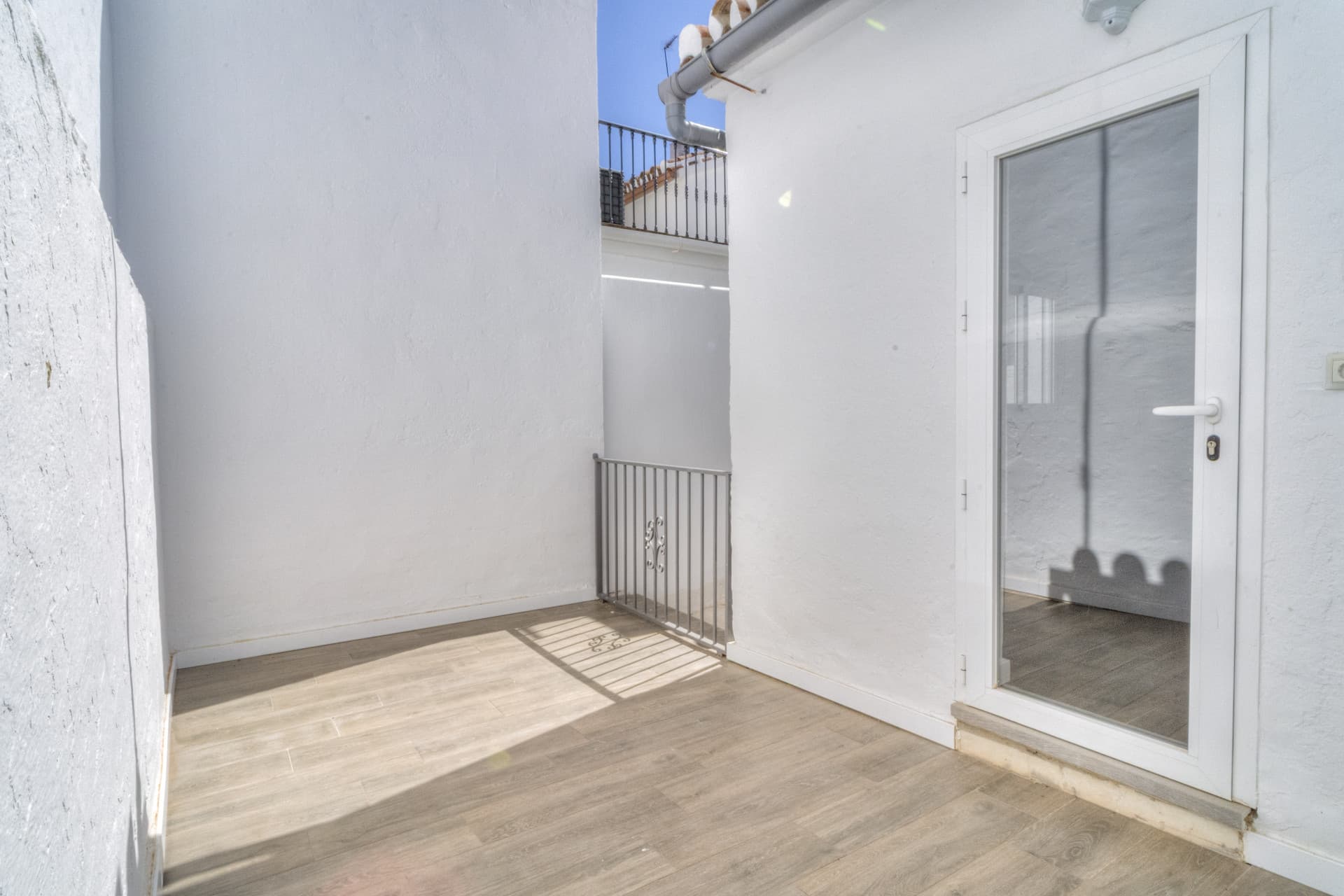
Coin's two kinds of town house — village casas in the old centre, modern terraces on the edge.
Town houses here fall into two camps, and it helps to know which one you're looking at. In the historic centre, around the streets behind Plaza Alameda and the church of San Juan, you'll find traditional casas de pueblo: whitewashed, two or three storeys, often narrow at the front but deep, frequently with a small patio or an azotea roof terrace looking over the tiled roofs to the Sierra de Mijas. Many need updating, and we'll always tell you which ones are priced for the work they need. On the outskirts and towards Los Llanos and El Naranjal, the town house means something different again: modern terraced rows in gated communities, typically three bedrooms over two or three floors, with a private garden or solarium and usually a shared pool and gardens.
As a rule of thumb, a habitable village house in the old town generally runs from the low six figures, while a renovation project can sit well below that. A modern townhouse in one of the communal developments typically lands a bit higher, with newer builds and the larger four-bedroom layouts at the top of the band. Buyers tend to be families wanting space and a garden without villa prices, couples after a lock-up-and-leave bolthole with a pool they don't have to maintain, and a steady run of people who take on an old-town casa as a renovation. We're happy to walk you through what a sensible refurbishment budget looks like before you commit.
Coín's three hundred orchards — a working market town, citrus farmland, and the coast half an hour away.
Coín sits at around 210 metres in the Guadalhorce Valley, between the Sierra de Mijas and the Sierra Alpujata, with Marbella roughly thirty kilometres south over the Monda pass and Málaga airport about thirty-five minutes to the east. It has been called the town of the three hundred orchards since Moorish times, and the name still fits — citrus, avocado and olive terraces run down towards the Río Grande on the western edge of the municipality. This is a Spanish market town of around 25,000 people, not a resort, and that is precisely why people buy here, for villas with land and pools at prices the coast no longer offers.
Who lives in Coín
Coín is first a town that works — farming, building trades, schools, an evening paseo — with roughly one resident in eight born abroad. British, Dutch and Scandinavian households cluster on the urbanisations east and south of town, many of them former coast-dwellers who swapped an apartment for a detached house and kept the same airport run. The British connection goes back further than most realise — the BBC built its Eldorado set at Los Barcos on Coín's outskirts in the early nineties — and alongside the retirees there is a steady flow of younger families and Málaga commuters, since the technology park at Campanillas is about half an hour away down the A-357.
Architecture & property types
Villas set the tone of the market here. The urbanisations that ring the town — Sierra Gorda to the north-west, Miralmonte about four kilometres east, Los Nebrales and El Rodeo among others — were laid out mostly from the 1980s onward, with detached houses on plots of five hundred to two thousand square metres, private pools and gardens that grow whatever you plant in them. Beyond the urbanisations, on rustic land, sit the country villas and fincas proper, some with a hectare or more of irrigated citrus still fed by the old acequia channels.
In town, the second strand of the market is the Andalusian townhouse — three storeys on the narrow streets around the sixteenth-century church of San Juan Bautista, with internal patios and roof terraces, some reformed to a high standard and plenty still waiting for the right owner. Ground-floor apartments are the most common flat type, mainly in low-rise blocks between the centre and the La Trocha commercial centre, and they suit downsizers who want level access, a terrace and a short walk to everything. Genuinely new construction is the exception rather than the rule; Coín is largely a resale market, which keeps its character intact.
Price expectations
You'd typically expect a town-centre townhouse to run from around €120,000 needing work to €250,000–€300,000 properly reformed. Ground-floor apartments generally sit between €120,000 and €220,000. Detached villas on the urbanisations mostly trade between €350,000 and €700,000, while country fincas with real land start around €400,000 and climb well past €1 million for the larger groves and equestrian properties. The honest comparison is with the coast — a Coín villa budget buys a Fuengirola apartment — and the honest caveat is that inland asking prices are often aspirational. We'll always tell you which Coín homes are over-priced and why, with the comparable sales to show for it.
Lifestyle, schools & getting around
Daily life centres on the town itself — tapas bars off the main squares, a periodic agri-food market showing off Guadalhorce Valley produce, and the Sunday rastro in La Trocha's car park, which draws bargain-hunters from across the province. The Día de la Naranja each spring celebrates the citrus harvest the town is named for, and the Río Grande valley to the west is where locals swim and picnic in summer. Golfers are better served than you might guess for an inland town — Alhaurín Golf, the Severiano Ballesteros-designed course above Alhaurín el Grande, is about fifteen minutes away, and Lauro Golf's twenty-seven holes roughly twenty.
Families have the town's own state primaries and secondaries, with Novaschool Sunland International — British curriculum, ages three to eighteen, school buses across the valley — about twenty minutes away at Cártama Estación. For getting around, the A-355 runs south through the Monda pass to Marbella in roughly half an hour, the A-404 heads east through Alhaurín el Grande to Fuengirola's beaches in about twenty-five minutes, and the A-357 takes you into Málaga city. The airport is a thirty-to-thirty-five-minute run. Buses connect Coín with Málaga and the coast, but realistically every household here runs a car, and most run two.
How we work in Coín
Inland buying is a different discipline from the coast, and we treat it as one. Before we recommend a viewing we check that the build matches the deeds, that anything on rustic land is legalised or honestly described, and that the water supply — mains, well or irrigation community — is what the listing claims. We'll walk away from homes we wouldn't buy ourselves, and we'll say plainly when an asking price belongs to a different market. If you're weighing Coín against the coast, or one urbanisation against another, drop us a line.