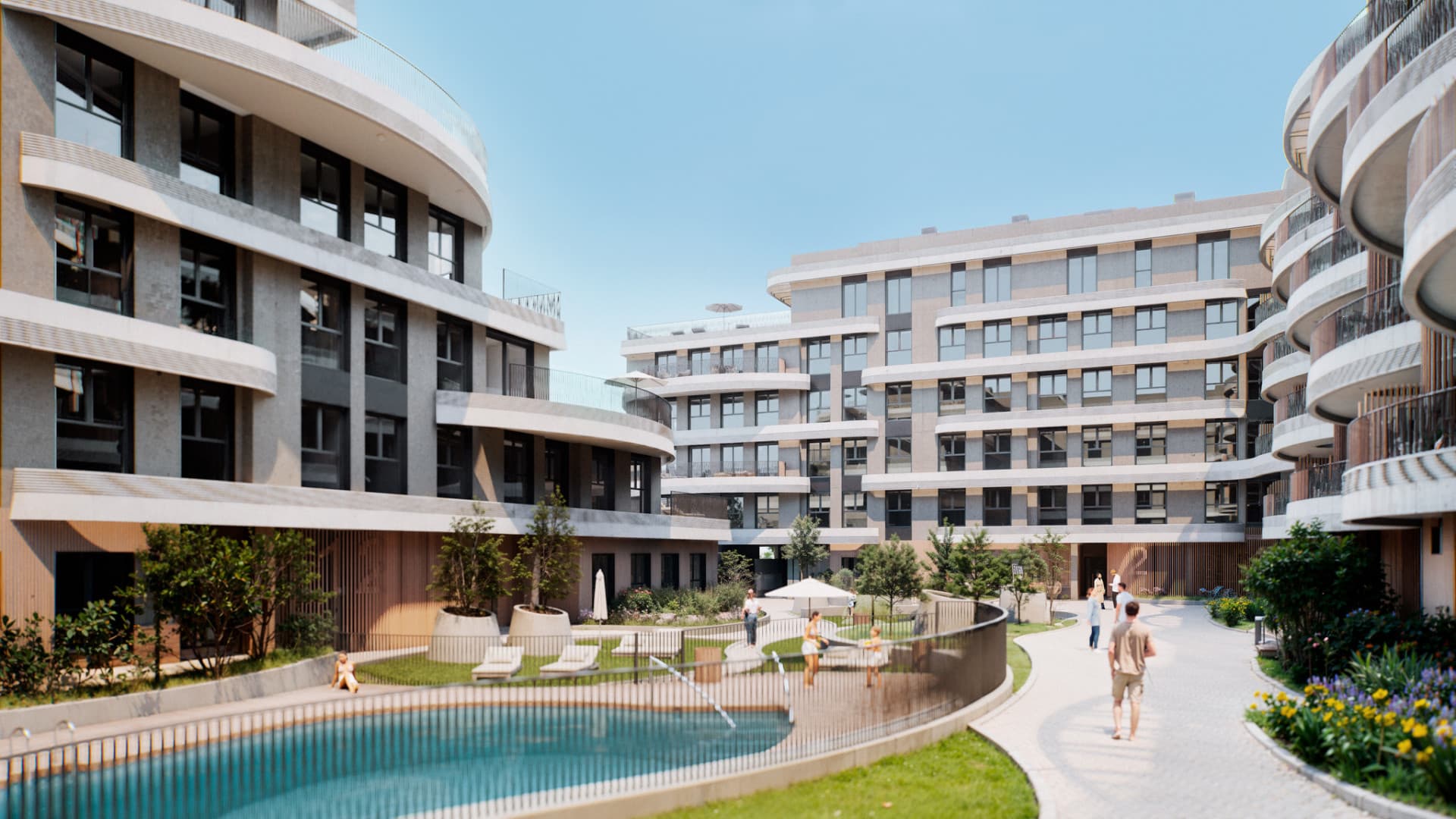
Malaga's bajo con jardin — a private garden, no lift, the house-feel of an apartment.
A ground floor apartment in Malaga — the bajo con jardin, as it is listed locally — gives you the part most flats cannot: your own patch of outdoor space at street level. Floor plans usually run two or three bedrooms across roughly 90 to 115 square metres of built area, paired with a private garden that can be anything from a courtyard of 25 or 30 square metres up to a generous 70-plus, often with a covered terrace as well. Many sit within gated communities sharing a pool and landscaped gardens, so the upkeep stays manageable.
On the east-coast side — El Limonar, Pedregalejo, El Candado — bajos tend to be older, lower-density blocks close to the beach, and prices reflect that address. Inland at Teatinos you will find a steadier supply of newer ground floor units, including recent promotions built around family living. As a guide, garden-level apartments generally start in the mid-400,000s to around 550,000 euros and climb past a million for the best-placed east-coast stock. They suit two buyers in particular: families who want a safe garden for children and pets, and older or less mobile buyers who would rather skip the stairs and the lift altogether. We'll always tell you which gardens are genuinely usable and which are shaded strips that look bigger in the photographs than they live in person.
Málaga, the Costa del Sol's working capital — a real Andalusian city with an airport, an AVE line to Madrid and a beach, not a resort that empties in October.
Most people meet Málaga on the way to somewhere else — a quick transfer at the airport, then off to Marbella or Nerja. We think that's a mistake. The city works year-round in a way the resorts don't: a historic centre that stays open in February, a culture scene serious enough to have drawn the Pompidou and the Carmen Thyssen, and residential districts that run from grand old sea-view villas in the east to value-led flats in the west. You get a genuine Spanish city, and you're still a fifteen-minute drive from sand. For buyers who want a life here rather than a holiday let, that combination is the whole argument.
Who lives in Málaga
Málaga is a proper mix, which is the point. The eastern coastal districts — El Limonar, Cerrado de Calderón, Pinares de San Antón — are old-money Málaga, full of Spanish families who've held the same villa for generations, alongside a steady international set drawn by the British School of Málaga and St George's nearby. Pedregalejo and El Palo, the former fishing quarters, attract a younger, more bohemian crowd who want the chiringuito life without leaving the city. In the centre and Soho you'll find remote workers, returning Spaniards and northern-European buyers — Dutch, Scandinavian, British, German — who'd rather have a city flat than a golf-resort apartment. Out west in Teatinos, Huelin and Carretera de Cádiz it skews younger and more local: students near the university, young professionals, first-time buyers and investors. There's no single 'Málaga buyer', and that's healthy.
Architecture & property types
Villas lead here, and they cluster in the east. In El Limonar, Cerrado de Calderón and Pinares de San Antón you'll find detached Andalusian-style houses — interior courtyards, terracotta, mature gardens and private pools — many dating to the early twentieth century, plus a run of newer contemporary builds on the hillsides above. Alongside the villas, apartments are the everyday currency of the city: solid family flats with terraces in the eastern districts and the centre, plus more affordable stock in the western neighbourhoods. You'll also see a healthy supply of ground-floor apartments — prized for their patios and direct garden access — and, at the top end, penthouses and duplex penthouses with wraparound terraces and sea or city views over La Malagueta, La Caleta and Pedregalejo. Broadly: villas in the leafy east, flats and penthouses through the centre and along the coast, the best value in the west.
Price expectations
Málaga is no longer cheap, and we'd rather you knew that going in. The eastern villa districts are the dearest: El Limonar typically runs from around €3,400 per square metre into the €5,000-plus band for the best frontline plots, and detached houses there and in Cerrado de Calderón regularly clear seven figures. Cerrado de Calderón and Pinares de San Antón generally sit around €2,500 per square metre. The historic centre and Soho are pricey for what they are — renovated flats often land between roughly €420,000 and €750,000, with old-town stock averaging well over €5,000 per square metre. The west is where the value lives: Teatinos, Huelin and Carretera de Cádiz typically start nearer €2,200 per square metre, and a two-bed in Carretera de Cádiz often lands in the mid-€200,000s. Riverside pockets marketed as a new 'golden mile' trade above €6,000 per square metre, which we think is a stretch — and we'll always tell you which homes are over-priced for the view or the postcode they're trading on.
Lifestyle, schools & getting around
Málaga Airport sits on the city's doorstep with direct flights across Europe, and the AVE high-speed train reaches Madrid in roughly two and a half hours, so weekends away and visiting family are genuinely simple. Inside the city a two-line metro, Cercanías commuter trains and a dense bus network mean you can live well without a car, though most villa-owners in the east keep one. For families, the British School of Málaga and St George's School sit near El Limonar and Cerrado de Calderón, both following an English curriculum through to A-Level. Golfers have the Parador de Málaga Golf beside the airport — eighteen holes right on the sand — and Real Guadalhorce a few minutes inland. Beaches run the whole front: La Malagueta and La Caleta in town, then the calmer sandy coves of Pedregalejo and El Palo to the east, where espeto sardines are grilled over driftwood fires on the sand.
How we work in Málaga
We know this coast inside out, and we treat Málaga as the city it is, not a brochure. We'll walk you through why a villa in Cerrado de Calderón is worth its premium and why a centre flat at €6,000 a metre might not be, which streets in El Limonar catch the afternoon breeze and which sit in shadow by four, and which 'sea view' actually means a sliver between two buildings. We're a small family agency, so you deal with Bianca and Omèr directly — no call-centre, no pressure, no inflated asking prices we quietly know won't hold. Whether you want an east-side villa, a Pedregalejo penthouse or a sensible flat in the west, we'll give you the straight version, the real numbers and the local knowledge that only comes from living here. If that sounds like the help you're after, drop us a line.